
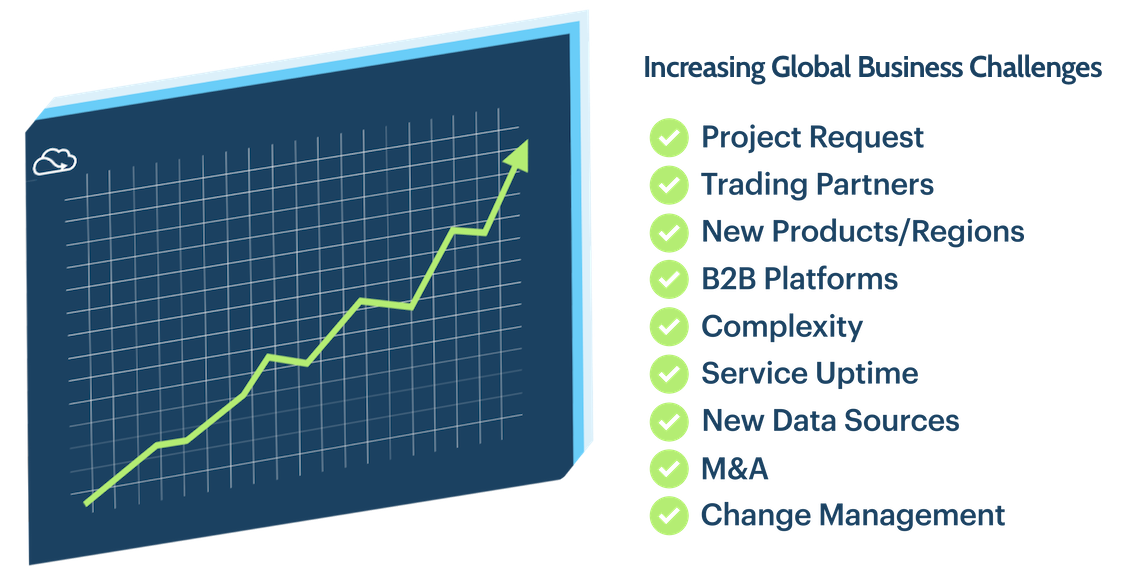
Pressure from customers, globalization, and supply-chain complexity is pushing more organizations into B2B and EDI programs. Complexity, cost, and “always on” operations reward a deliberate strategy.
Integration strategy
Leaders understand ROI on integration investments; deploy EDI alongside APIs, IoT, raw file, WebEDI, telematics, and ELD patterns; run a center of excellence with governance; invest in a unified iPaaS-class platform that extends to cloud, hybrid, partners, and devices; and use onboarding tooling (mapping, orchestration, connectivity, community management) to compress time to value.
Laggards run redundant or aging silos, rely on minimal on-premise point tools, and lack a coherent B2B automation strategy.
Implementation services, flexibility
Leaders avoid lock-in to a single managed-services model; use self-service or SI partners when appropriate; adopt hybrid models (in-house augmented by managed services); and leverage partner self-onboarding when the platform supports it.
Laggards lack skills when spikes hit, or are tied to rigid service contracts that do not flex with the business.
Process automation
Leaders design for automation across multi-enterprise processes, use real-time operational dashboards, and manage by exception with clear visibility into failures.
Laggards depend on phone, email, and fax for exceptions, harming data quality and response time.
Business continuity
Leaders run integration across multiple data centers and regions with strong uptime SLAs and incident processes.
Laggards rely on single-site deployments with little redundancy.
Security and compliance
Leaders meet requirements for PII, PCI, SOC 2, GDPR, and related regimes; encrypt data in transit and at rest.
Laggards leave gaps versus regulatory expectations or still rely on insecure legacy transports such as plain FTP.
Conclusion
Modern cloud iPaaS plus optional managed services typically offers the best balance of capability and flexibility for digital transformation: always-on infrastructure, strong security posture, scalable elastic capacity, multi-endpoint onboarding, orchestration across SaaS, on-premise, partners, and devices, real-time visibility, and transparent commercial models.